
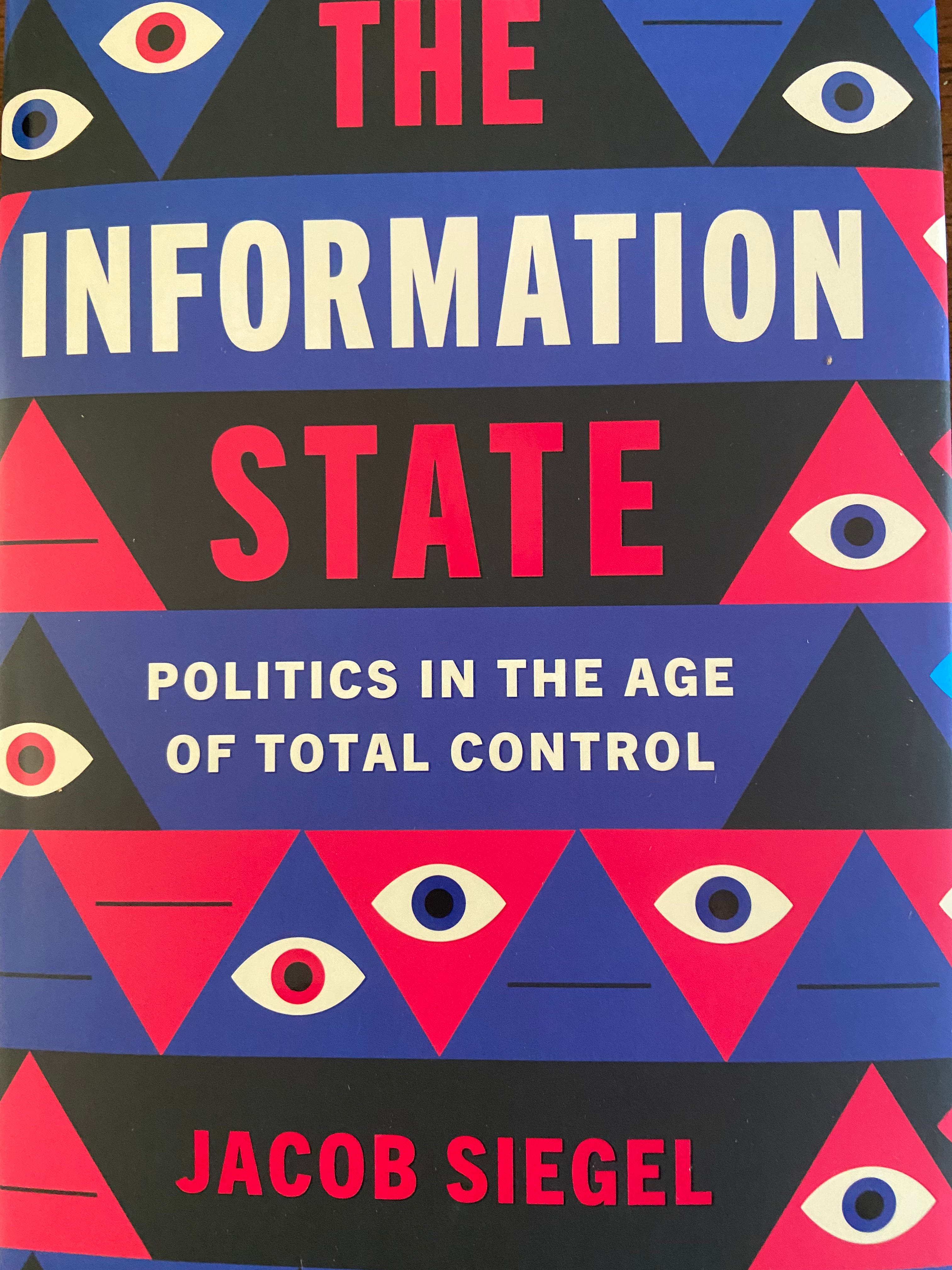
Jacob Siegel’s The Information State does not disappoint. Though there have been efforts to describe the appearance of the contours of a web-based totalitarianism on the American shores, Siegel embeds his version in a hundred-year contemporary history of the changing relationship of American government with information. He goes even further back in time to establish a framework that explains some of the effects exerted by the information revolutions throughout the centuries on power and authority and the way they are exercised.
The core of Siegel’s narrative starts with President Wilson and the policing of opinion he introduced in a political landscape hitherto conditioned by the First Amendment of the Constitution. Background to this radical departure from the American model was not only Wilson’s opportunism in seizing an internationalist direction after having been elected on a rather different platform, but the growing prominence of a technocratic belief system as well. Technocracy – the idea that who should hold the reigns of society is not a particular stratum of society, but rather a group of ‘technical experts’ – has emphatically bobbed up its ugly head again in recent times. What is remarkable about Siegel’s framing is not only the historical value of tracing the rot to its earliest beginnings, but it also marks the continuity – and really the increasing complexity – of societies wedded to freedom of speech in a world, including enemies and adversaries, where information travels farther and faster all the time. The Information State ultimately tells us the story of the weapon of propaganda being turned inward, rendering the original reason for defense against foreign propaganda a sorrily moot point.
Parallel to Siegel’s history of modern propaganda and information warfare he tells us the story of the machine that has made the current version of totalitarian society possible: the computer. That the computer is not merely a consequential tool used to implement ideas of control developed in a separate realm, but that both, rather, are the product of the same thinking process is something that is amply illustrated by Siegel in insightful passages. To reverse the worrisome developments described in his book, however, we may need to dig and expose another level or two – as I hope to explain towards the end of this review.
Just as The Information State was reminding me of David Halberstam’s better work, Siegel tied in (my memories of) the former’s The Best and the Brightest (about the escalation of the Vietnam war from the perspective of the American policy makers) with his own description of the same period. Halberstam explained the obsessive focus on measurable metrics (including most notably the body count) of Secretary McNamara as the result of his background in business. Siegel, in the context of his exploration of his own hypothesis, takes this a step further. He realizes that the obsession is not with the numbers, per se, but with the control McNamara believes these are able to deliver. McNamara thus becomes part of a longer battle, as “[s]tarting in the nineteenth century, the extraordinary material surpluses created by the Industrial Revolution caused a “crisis of control” that necessitated the invention of modern information technologies.”
Logically, most of the book addresses more recent stages of our history, when those technologies had come to bloom and under the pressure of events coming from outside (9/11, the Russian occupation of Crimea, Covid-19), several reactions sprang forth from the intelligence community that culminated in the foretaste of the 1984sequel that we have all witnessed and waded through the last quinquennial. One element of course was the confidence that the collection of unlimited data would lead to improved security. Another one was Obama’s shift from counterterrorism to “CVE”, or “countering violent extremism,” which would eventually set up America for the big rotation of the looking glass, from peering out, to spying us. The third element was the mother of all “public/private partnerships”, the alignment of Big Tech with the American intelligence agencies, which proliferated under Obama as well. Eventually, this not fully formal setup would culminate into the Biden administration sending its directives to a range of tech companies to violate the constitutional rights of citizens in a manner even the handlers of the autopen were well-aware they could not do out in the open.
Siegel describes all these passages of our recent history with due detail, involving more intricacies than I could faithfully render in the present format. Anybody interested to learn how we got into a situation where we all are routinely spied on, are nonchalantly disappeared on the public squares that have become the substitute for Athens’ agora, and have quietly become not only objects but also the subjects – after having been neutered of our agency – of counter-information campaigns, should read The Information State. If we want to change the direction of this overture to a new totalitarian world, we better know how to identify the mechanisms used to implement it. Personally, I believe we need more to change the actual course of society. Discourse on woke cancel culture has recently resulted in the awareness that the behavioral patterns are not reserved to any exclusive political orientation. This outlook, unfortunately, reflects elements in our common culture. I believe we have to understand that technocracy is not a problem exclusive to any political creed, party, or ideology, either.
Siegel identifies an essential characteristic of the technocratic class that has set up the all-seeing Panopticon: an increasing difficulty to perceive reality. If the ‘rona showed us anything, it was exactly this. Large swaths of society – ‘experts’, officials, and civilians – became so possessed by a model of reality, that they could no longer see reality itself. Of course by our instincts of accountability and responsibility, we would rather see this as a willful action, as an occasion to attribute guilt. That is why, paired with the technocratic illusion of creating a world that corresponds 100% to the figments of their algorithms, we see the proliferation of conspiratorial theorists who, while posing as the opponents of the technocrats, effectively share the same fantasy of total control. But perhaps it is exactly the obsessive focus on analytical understanding, which has produced our present world of binary models, that is delivering us in a vicious cycle. If we refine our focus one more time, will we finally get to safety? Alas, what happens is the opposite. If this is how we hope to control, we will only be controlled. But this is only my suggestion for further reading, and more profound empowerment: The Master and His Emissary, by Iain McGilchrist.
Do read The Information State if you want to have a clear idea of the political and the illicit processes that brought us, largely undetected, into a state of ever unsatisfied control. If you want to reverse this tendency, you had better arm your mind.
Further reading
My review of Iain McGilchrist’s masterpiece about the fundamental problem of our culture:
The Master and his Remote Control

Before I even start, it is only fair to say that this brief review can never do justice to this book, Iain McGilchrist's The Master and his Emissary. You should all read it. I wish I had read it before, as it confirmed an idea I had been trying to develop over the past ten years. The paradox I had observed is that even though a progressively large porti…
A first chapter of a dystopian novel in the times of virtual connection:

For the one and only upstart novel about a startup social-media platform: