
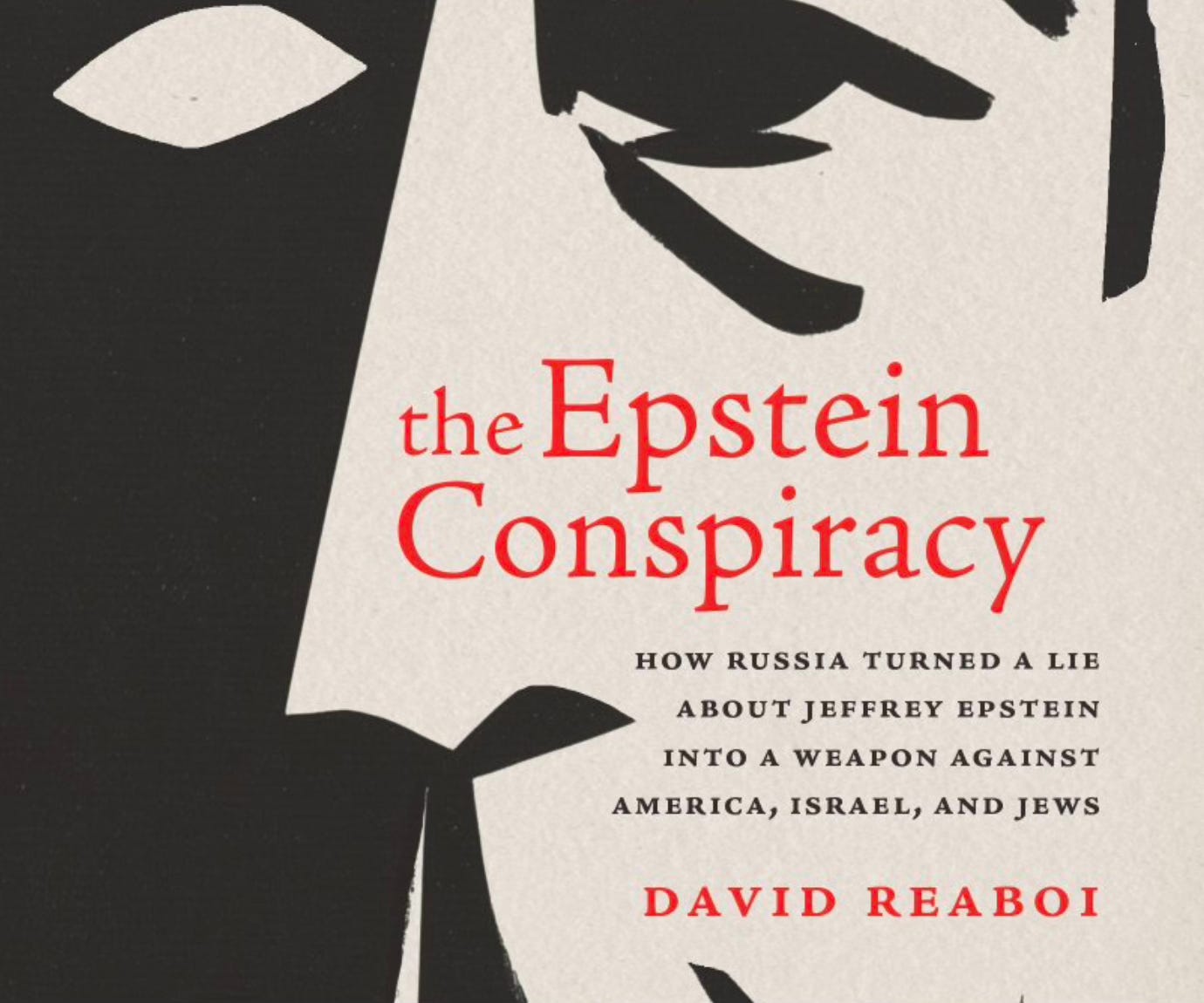
In his book The Epstein Conspiracy, David Reaboi presents the reader with the results of his open-source investigation of the nascence and spread of the claim linking sex-convict and multi-millionaire Epstein to Israeli intelligence services. It inevitably is an open-source investigation for the simple reason that any material deriving from intelligence services - of whatever nationality - naturally is unavailable. Does this blunt the cutting edge of this study to tear apart this conspiracy theory itself? Of course it does. But this is beside the point, as well as external to Reaboi’s objective in writing this book. Not only is the conspiracy theory as a category, qualitate qua, unfalsifiable. One of its psychological appeals to adherents of course lies in this very law of the craft: it is the initiates who have the insight that grants them a special, moral, if not quasi religious status. But we are getting ahead of things.
At the moment, the claim that Jeffrey Epstein really headed a blackmail operation, resulting in political clout that a foreign country ably wields so as to decide the policies of the most powerful country in the world, the US, has been pumped through the air waves and social media so constantly, that it has become part of the background noise. In The Epstein Conspiracy, Reaboi tracks exactly when and how this claim was made for the first time, and not only how it got quantitatively distributed, but also in a way so as to make the flimsy origins of the whole story disappear. Reaboi describes this process in a set of separate chapters and steps. And it turns out that this process is perfectly traceable by checking open sources - after all, this is the sphere in which the story was seeded, laundered, and spread.
Reaboi names these stages Seeding, Supply, Laundering, and Activation. By analyzing and identifying these distinct steps, reducing the tsunami of clicks, shares, and copy/pasting to its practical original. This allows the reader, instead of lifting his hands in the air in powerless desperation, to see the flimsy origins of a proliferating conspiracy theory. It turns out that a single questionable source, making assertions without evidentiary proof, is sufficient in our current information system to organize the recruitment of hoards upon hoards of believers. As Reaboi correctly points out, this is not a harmless phenomenon - regardless of the topic at stake - as it carries cognitive consequences for those diving into conspiracy rabbit holes. Once proof to the contrary can only be understood as confirmation of the truth of one’s beliefs, the subject’s capacity for critical judgment and reasoning itself are hampered. The danger, therefore, of any single conspiracy theory is loaded with the impact on the critical reasoning of the subjects. That this effect fits hand-in-glove with the geographical and historical origins of conspiracy statecraft is a point we will return to later. Let us first look at the stretch of contemporary history within which the instant Epstein myth has come upon us.
The seeding of the myth, as Reaboi shows, goes back to July 2019, while its current activation has been taking place over the past two years. If the central organizing principle of the Epstein myth is the idea that ‘Zionists’ control the United States, this temporal context should not be ignored. If the myth creates tension in the alliance between Israel and the United States, who stand to profit from it is the proxy system that Israel has been at war with in Gaza, Yemen, and Lebanon. But we should not forget, either, that the Islamic Republic of Iran is a proxy in its turn. The latter had divided influence in Syria with its patrons in Moscow, until both had to write off yet another territorial investment while the Muscovites have been ground down in their three-day special military defeat in Ukraine. There also is a backdrop that cannot be described in geopolitical terms, though perhaps it was the consequence of the collapse of the Soviet Union and its pole of global influence.
Especially during the ‘rona, many have become aware of the spy glasses of our own intelligence services being turned inward. Following their build up during the Cold War and the War on Terror, their subsequent overcapacity and acumen were spent on surveilling the own citizens. (I reviewed two books linked to this theme, which you can read here and here.) This proliferation of the home-grown surveillance state has proven to be a fertile breeding ground for distrust of the (own) authorities and hence the belief that any lack of transparency is not there not protect stupidity, incompetence, and a certain level of corruption, but, quite simply, to hide the puppeteers who rule the world, us unwitting (except, of course, for the initiated!). What has been striking to see in this information environment, is that theories about the evil doings of the United States (CIA plots and coups, NATO aggression, multi-polarity, yada yada yada) have abandoned the hotbed of socialist fellow travelers and have landed instead in a section of the political right, not solely in the United States. Personally, I believe this phenomenon of floating propaganda must be understood as more than the consequence of paid distribution networks, as our era has come to believe so profoundly in total control, that we must always imagine someone’s hand behind the next event. (I wrote a short piece on the Libertarian gateway to this credence, and their worldview as inverted Marxists here.)

But let us return to Reaboi’s book. Without delving into the hypothesis suggesting that Epstein effectively inherited the chest of KGB cash that was shipped to the West via Robert Maxwell as the Soviet Union was crumbling, he does lay out the circumstances linking both victims of mysterious death (yes, via Maxwell’s daughter, but not only) to Russian, rather than Israeli, intelligence. In particular, the very figure responsible for seeding the Mossad theory, was documented as a dealer of political stories and lobbies, more often than not involving a Russian triangular interest. So if Reaboi manages to document Russian state media playing a pivotal role in spreading a myth that would overwrite a more plausible theory, we can finally discern a coherent pattern between the geo-political situation, our information environment, and the role played by Podcastistan as a mediator. Now you may have heard of Aleksandr Dugin as ‘Putin’s brain’ (a heavily contested moniker, by the way) or as the promoter of the mystical concept of Eurasia, and more likely as the champion of the ‘multi-polar world’. But Reaboi lifts the mystery of this Russian’s role in our very own Podcastistan once and for all.
Not only does Reaboi explain exactly what links Dugin has with Soviet/Russian intelligence. He also dispels, even if implicitly, the myth we have imposed on our view of Russia itself. In our ideologically organized worldview, we apply specific caesurae on Muscovite history. We refer to Czarist Russia, to the liberal short-lived opening of 1905, to the ‘Russian Revolution’ of 1917 in the wake of the disastrous Russian bid in WW I. We think of the collapse of the Soviet Union, and Yeltsin’s chaotic disassembly of the Soviet Union. This habit of organizing history along these lines and pivotal points, however, blinds us to the continuity in the conception of power and citizenship that has not essentially changed over the past 120 years in the Muscovite empire. It is not Reaboi who illustrates this argument, but Dugin, of whose book Konspirologiya Reaboi publishes, at long last, extensive excerpts in the English language.
What framework of continuity does Dugin reveal in his Konspirologiya? He offers an associative crash-course in conspiracy thinking, off of the czarist-intelligence fabrication of the Protocols of the Elders of Zion, the inspiration of pogroms in Russia then, the Middle East today, and one of the main sources of modern Jew hate, including national socialist theories. Why does Dugin have a particular interest in Jew hate? Because, according to him, it is the archetype of conspirology itself. Hatred of Jews weaves itself, both deliberately and ‘spontaneously’ in a myriad of conspiracy theories. Without getting into the specifics of his explanation, this approach should give us a moment’s thought.
It is often said that Jew hate does not stop at the Jews, eventually. While this is true in its original meaning, there is an underlying sense in which Reaboi’s book should serve as a warning for all of us. Because if the deployment of Jew-centered conspiracies has demonstrated anything regarding the society that has excelled in this field for over a century, it is that the belief in all-powerful cabals and the deactivation of critical thinking has a profound effect on the carriers of such theories. After all, what we see in Russian society is the spirit of compliance and the relinquishing of the belief in the individual’s agency. A country ready to tacitly hand over its sons, by the hundreds of thousands, for a senseless war of empire demonstrates how far removed we are from that mindset still. And it should serve as a loud warning as to the intent of Dugin’s mouthpieces in the West. And let it be a simple explanation for the state of a series of our own ‘independent’ scholars and commentators, who may not reside in Podcastistan but are an illustration of Russian tradecraft that prescribes to always take control of the entire chessboard. When we look at the chessboard, we may think we see (political) affiliations, factions, and ideology. Vladimir does not.
Anyone interested in understanding where the (prominence of the) Epstein myth comes from should grab a copy of Reaboi’s book. Let reading it serve as a warning on several levels. Of course it holds a warning against the construction of hateful drivel implicating a group of people. But the book should clear up as well that the objective behind the Epstein myth, politically and presently, is our alliance with the only country in the Middle East that we share a wide array of values with. But underlying these incontestably important issues lies the truth laid out above: it is the consumers of the drivel that will ultimately be reduced to the state of the serfs the mother of all konspirologiya was intended for. If you believe we can maintain a commonwealth of liberty and self-determination by screaming our discourse inside their padded echo box, think again. Finally, Reaboi points out that the World Wide Web has been a playing field for many foreign adversaries. For a number of reasons, we have chosen to undergo acts of propaganda and low-intensity warfare, rather than confront them in a meaningful way (using those events for purposes of domestic politics has proven to give the worst possible outcomes). As we finally are waking up from the dream that the rest of the world would silently and smoothly turn into a copy of ourselves, it is high time we conceive of a relationship with the rest of the world that is based on reciprocity.
Raboni exposes the anatomy of disinformation, where confirmation bias is the delivery mechanism and antisemitism is the pre-packaged script. Sad times we live in, my friend.
This is so well done. Thank you.